

Chandigarh: Heavy rains and swelling rivers have plunged Punjab into one of its worst flood crises in recent years, leaving vast swathes of farmland inundated and thousands of residents stranded. With the Sutlej, Beas, Ravi and Ujh rivers flowing above danger levels, floodwaters surged into villages across Pathankot, Hoshiarpur, Gurdaspur, Kapurthala, Tarn Taran, Fazilka, Ferozepur, Barnala and Mansa districts on Tuesday, prompting the state government to sound a statewide alert.
The calamity turned fatal in Barnala, where an 11-year-old boy was electrocuted in Tapa town. In Amritsar, three abandoned buildings collapsed under the weight of incessant rain, though no casualties were reported. Authorities have confirmed that the worst-hit areas were Pathankot, Hoshiarpur, Gurdaspur, Kapurthala, Tarn Taran, Fazilka and Ferozepur, where floodwaters breached embankments and swept through standing crops, leaving farmers devastated.
According to the administration teams of Army, BSF, NDRF, SDRF and Punjab Police are deploying boats and helicopters to evacuate stranded families. In Pathankot’s Taas village, seven members of a family remained trapped as rescue teams struggled against strong currents to reach them. More than 70 residents of Jagochak Tanda village were airlifted to safety, while dozens were evacuated from Lasaniya and nearby hamlets.
Punjab Water Resources Minister Barinder Kumar Goyal, who visited Pathankot and Gurdaspur, said around 1.1 lakh cusecs of water had to be released from the Ranjit Sagar Dam following heavy precipitation upstream, causing the Ravi to swell dangerously. Breaches in embankments along the Ravi inundated several villages in Dinanagar tehsil of Gurdaspur, where at least 15 villages have been affected. In Makora Pattan, entire villages such as Chak Ram Sahay and Makora have been submerged, while others remain cut off. Additional Deputy Commissioner of Amritsar Rohit Gupta placed 14 villages in Ajnala subdivision on high alert as the Ravi continued to rise.
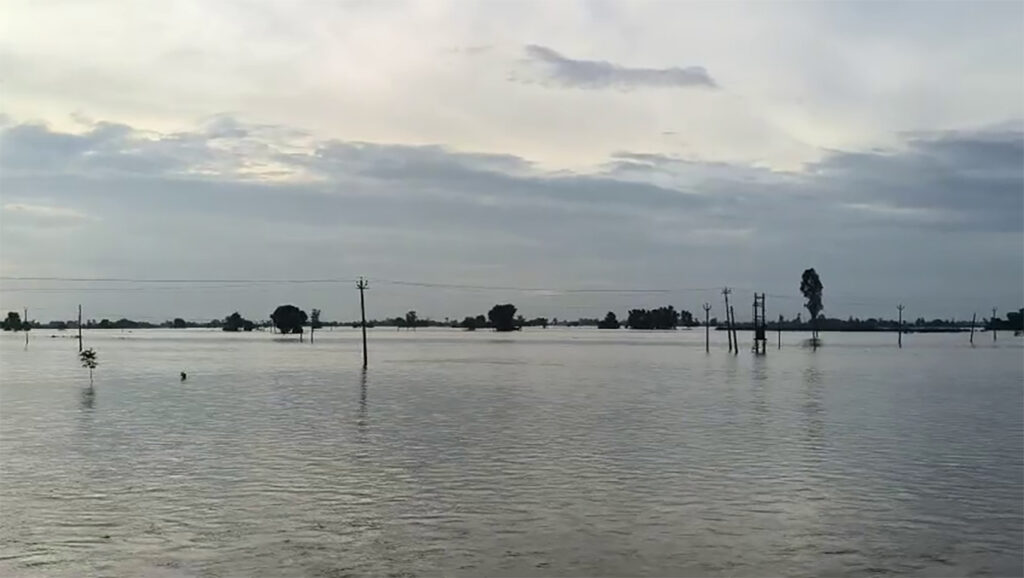
The crisis extended to other regions as well. In Ferozepur and Fazilka, the release of 2.2 lakh cusecs of water from Harike headworks forced families in low-lying areas to abandon their homes.
In Moga’s Dharamkot subdivision, Sanghera village was transformed into an island, completely encircled by the swollen Sutlej.
A breach in a drain at Kulana village in Mansa district submerged paddy fields, compounding the misery of already distressed farmers.
Barnala and Mansa towns remained waterlogged for a second straight day, even as Shiromani Gurdwara Parbandhak Committee (SGPC) volunteers set up relief camps for those displaced.
Rail traffic also suffered after the Chakki river eroded tracks in Pathankot, suspending services on the Pathankot Cantonment–Kandrori section and forcing widespread cancellations and diversions.
Punjab Chief Minister Bhagwant Mann conducted an aerial survey of the affected belt from Makhu to Harike Patan and announced a special girdawari to assess crop losses.
As floodwaters continued to rise and weather forecasts warned of more rain, Punjab braced for a prolonged battle against nature’s fury. With homes marooned, crops devastated, and infrastructure crumbling, the state’s immediate priority remains to save lives, while the long-term challenge of rebuilding has already begun to loom.
The state government ordered the closure of all schools, government and private, from August 27 to 30 as a precautionary measure to ensure children’s safety amid the flood emergency.
After Two Weeks of Effort, Farmers Watch Beas Breach Bundh
The crisis deepened in Kapurthala district when the Beas river breached an advance bundh at Ahli Kalan village near Sultanpur Lodhi on 26 August morning, despite desperate attempts by farmers to reinforce it with earth bags and machinery.
The breach is expected to inundate thousands of acres in the Mand area, devastating standing crops. Farmers had guarded the bundh for over two weeks, even receiving support from Rajya Sabha MP Balbir Singh Seechewal, who provided equipment and volunteers.
After the collapse, more than 45 residents, including women and children, were evacuated, while 15 families and their livestock were relocated to safer places.
Relief arrangements were set up by the Shiromani Gurdwara Parbandhak Committee at Gurdwara Ber Sahib in Sultanpur Lodhi and other local shrines to house the displaced.
⊕ ALSO READ – Historic Gurdwara Kartarpur Sahib Flooded After Release of Water in Ravi River

![Left to Right: Jagtar Singh Johal, Umar Khalid and Sharjeel Imam [USCIRF Freedom of religion or belief (FoRB) prisoners] | File Photos](https://sikhsiyasatnews.net/wp-content/uploads/2026/09/Jagtar-Singh-Johal-Umar-Khalid-and-Sharjeel-Imam-USCIRF-freedom-of-religion-or-belief-FoRB-prisoners.jpg)


