
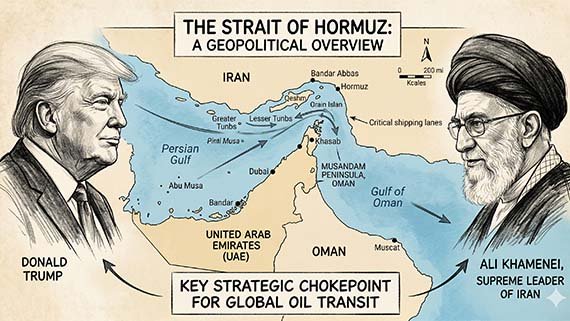
The Strait of Hormuz is widely considered the world’s most critical maritime energy chokepoint. Connecting the Persian Gulf to the Gulf of Oman and the Arabian Sea, it is an irreplaceable artery for international energy markets and global economic stability.
Here is a detailed breakdown of its strategic importance, trade dynamics, and the current geopolitical situation.
Basic Statistics: Passage & Global Supply
Prior to the severe disruptions that began in early 2026, the Strait handled a massive volume of global trade:
- Daily Vessel Traffic: The Strait historically averaged around 138 to 153 commercial ships per day.
- Oil Supply: In 2025, an average of 20 to 20.9 million barrels per day (mb/d) of crude oil and refined petroleum products passed through the waterway.
- Global Share: This volume represented approximately 20% of total global oil consumption and roughly 25% to 27% of all seaborne oil trade.
- Natural Gas: The passage is also vital for liquefied natural gas (LNG), handling about 20% of global LNG trade. This includes 93% of Qatar’s and 96% of the UAE’s total LNG exports.

Major Exporters & Commodities
The Strait is the primary, and in many cases only, maritime exit route for Gulf producers. The major commodities exported are crude oil, condensates, refined petroleum products (like diesel and jet fuel), LNG, and agricultural fertilizers (such as ammonia and urea).
The top exporters of crude and condensate flowing through the Strait include:
- Saudi Arabia: ~37.2% of the Strait’s volume (roughly 5.5 mb/d)
- Iraq: ~22.8%
- United Arab Emirates: ~12.9%
- Iran: ~10.6%
- Kuwait: ~10.1%
Major Importers: Who Gets What?
Asian markets are overwhelmingly reliant on this chokepoint, absorbing nearly 90% of the oil and LNG that transits the Strait.
- China (37.7% of Hormuz oil flows): The largest single importer, receiving roughly 4.8 to 5.4 mb/d. This accounts for up to 40% of China’s total oil imports and 30% of its LNG, making the Strait critical to its manufacturing and supply chains.
- India (14.7% of Hormuz oil flows): Receiving around 2.1 to 2.5 mb/d, the fast-growing economy is acutely vulnerable to disruptions here. Nearly 50% of the nation’s total crude oil imports and over 50% of its LNG imports pass through Hormuz, sourced heavily from Iraq, Saudi Arabia, and the UAE. Furthermore, regional food security hinges on this corridor, as over 75% of imported urea and vital agricultural fertilizers arrive from Gulf nations.
- South Korea (12.0%) & Japan (10.9%): Both nations lack domestic energy resources and rely heavily on Middle Eastern crude and Qatari LNG to power their industrial economies.
Historical Blockades
Historically, a complete, prolonged closure of the Strait has been rare, though it has frequently been a flashpoint:
- 1980s Tanker War: During the Iran-Iraq War, both sides attacked commercial shipping, but the waterway remained navigable.
- 2011–2012 & 2018–2019: Amid escalating US sanctions, Iran repeatedly threatened to close the Strait. This period saw several asymmetric attacks on oil tankers and the seizure of vessels (such as the British-flagged Stena Impero), but a full blockade was never executed.
- February 2026 (Drills): Iran conducted a rare temporary closure of parts of the Strait for live-fire naval drills shortly before the current crisis erupted.
The Present Situation (March 2026)
The geopolitical landscape fractured heavily in late February 2026 following joint US and Israeli military strikes on Iran, marking the onset of the 2026 Iran War. The Strait is currently experiencing a severe, de facto closure.
- Traffic Collapse: Daily transits plummeted from over 138 ships to single digits, occasionally dropping below 5 ships a day. Chinese, Indian, and Western vessels alike have been forced to idle in the Gulf of Oman or the Persian Gulf.
- Attacks & Insurance: Following warnings from the Islamic Revolutionary Guard Corps (IRGC), several merchant ships were struck by drones and projectiles. Consequently, maritime insurance providers stripped war-risk coverage, making the route economically unviable for shipping companies. Major energy firms have invoked force majeure on their Gulf contracts.
Why It Is Difficult to Reopen
If the Strait remains blocked by a hostile actor, forcefully reopening it is incredibly difficult due to geographic and logistical realities:
- Geography: The Strait is only 21 miles wide at its narrowest point, and the actual navigable shipping lanes are just two miles wide in each direction. This forces large, slow-moving tankers into a predictable, narrow path.
- Asymmetric Warfare: The confined space makes commercial shipping highly vulnerable to shore-based anti-ship missiles, fast-attack drone boats, and naval mines deployed from the Iranian coastline.
- Lack of Alternatives: Existing pipeline bypasses through Saudi Arabia to the Red Sea or the UAE to the Gulf of Oman max out at around 3.5 to 5.5 mb/d of capacity. This leaves roughly 14 mb/d of oil with absolutely zero alternative export routes.
Risks of US Attempts to Reopen It
Any direct military intervention by the United States to secure and reopen the Strait carries severe strategic risks:
- Regional Escalation: A kinetic campaign to clear Iranian coastal defenses and naval assets would risk expanding into a protracted, theater-wide war, potentially drawing in neighboring Gulf states and devastating regional energy infrastructure.
- Naval Vulnerability: US warships operating in the tight, shallow waters of the Persian Gulf are exposed to anti-access/area-denial (A2/AD) networks, including advanced missile batteries and minefields.
Economic Shock: A military conflict directly in the shipping lanes would ensure that commercial vessels stay away indefinitely. This would lock in record-high global energy prices, trigger massive supply chain disruptions, inflate food prices due to fertilizer shortages, and likely push the global economy into a severe recession.