Ropar/Chandigarh: A high-level delegation of the Ravi-Beas Water Tribunal was forced to abort a scheduled inspection in Ropar district on Friday, February 6, 2026, following a massive protest by local residents and farmers that brought traffic on the National Highway to a standstill.
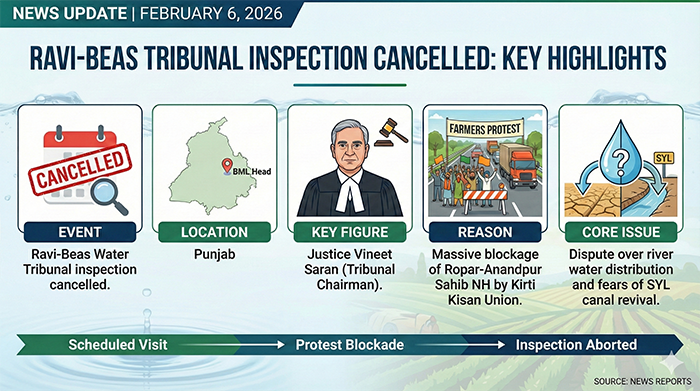
The delegation, led by Tribunal Chairman and former Supreme Court Judge Justice Vineet Saran, had arrived to conduct field visits to the Bhakra Main Line (BML) Head and Lohand Khad near Kiratpur Sahib. The inspection was part of the tribunal’s ongoing mandate to adjudicate the distribution of surplus waters from the Ravi and Beas rivers among the stakeholder states of Punjab, Haryana, and Rajasthan.
Standoff at National Highway
The situation escalated when the delegation encountered a fierce sit-in protest at Bunga Sahib on the Ropar-Anandpur Sahib National Highway. Led primarily by the Kirti Kisan Union, hundreds of protesters blocked the route, effectively preventing the officials from reaching the inspection sites.
The blockade resulted in severe traffic disruption, with local reports indicating vehicle queues stretching nearly 30 kilometers back toward Ropar.
Ropar Deputy Commissioner Aaditya Dachalwal confirmed that the inspection could not proceed.
“The tribunal members were unable to reach Lohand Khad due to the blockade. We will plan another visit after further consultation with the tribunal,” Dachalwal stated.
Senior Superintendent of Police (SSP) Maninder Singh noted that the delegation was moved to a local guest house for their safety before the visit was officially deferred. The protest was called off only after the administration confirmed the cancellation of the inspection.
Fears of SYL Revival
The protest was driven by deep-seated apprehensions among farmer unions that the tribunal’s activity signals a precursor to reviving the controversial Sutlej-Yamuna Link (SYL) Canal project.
Veer Singh, a leader of the Kirti Kisan Union, strongly condemned the tribunal’s presence, citing international riparian principles.
“This tribunal is not valid under international riparian principles, which state that a tribunal can only be formed if there is a dispute between riparian states. Punjab is already facing acute water scarcity and falling groundwater levels. We will not allow a single extra drop of water to be transferred.”
Singh further revealed the tense atmosphere at the guest house, stating that the union had issued a warning that the delegation would face a gherao (encirclement) if they did not leave the district immediately. The delegation subsequently vacated the guest house by evening.
Protesters at the site warned that any diversion of river water would have catastrophic effects on Punjab’s agriculture, threatening to turn the state’s fertile land into a desert.