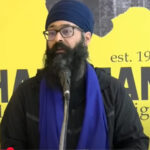

Baku, Azerbaijan: Delegates of Sikh Federation International (SFI) attended a historic conference in Baku, Azerbaijan this week, which focussed on India’s violence against the Sikh people and the ongoing struggle to establish an independent Sikh homeland, Khalistan. The conference was organized by the Baku Initiative Group (BIG) which hosted Sikh leadership from around the world in order to interact with students, academics, legal experts, and civil society organizations based in Azerbaijan. Dozens of regional media outlets covered the conference in detail, ensuring that Sikh voices were taken directly to members of the local community in their own languages. Participants learned about the history and ongoing legacy of the Sikh genocide as well as Indian repression of Sikh dissidents advocating for an independent Khalistan.

The conference was inaugurated by Executive Director, Abbas Abbasov, who began the meeting with a moment of silence for Shaheed Bhai Hardeep Singh Nijjar and others killed by Indian state violence. The remainder of the proceedings were jointly moderated by Baku Initiative Group and Sikh Federation International. Sikh representatives detailed the systemic origins of state violence against the community since the illegal annexation of Punjab in 1849 and spoke about the current day dynamics of the ongoing
struggle to restore Sikh sovereignty.

The Baku Initiative Group took the opportunity to publicly release an informational booklet titled, “The Khalistan Movement: Past Roots, Global Dimensions and Modern Landscape” while numerous media outlets interviewed SFI representatives in order to educate their international viewership about the Sikh cause in their local languages. Local attendees expressed their solidarity with the Sikh people, noting their region’s own struggles for self-determination which led to the independence of several republics in the early 1990s, including Azerbaijan’s own independence in 1991.

At the end of the conference, Mr. Abbasov read a joint statement released on behalf of BIG and SFI which called on the international community to take decisive action on India’s violence against the Sikh people. The statement called on governments, civil society organizations, and international institutions to demonstrate their solidarity by standing with the Sikh people in our pursuit for freedom and justice.
Delegates also acknowledged the historic ties between the Sikh people and the people of Azerbaijan, as well as the broader Central Asia region. Rather than a new introduction, delegates described the meeting as a renewal of the centuries old relationship steeped in deep cultural, economic, and political exchange along the historic trade routes running through the region. These ties were not only built on lasting economic ties but represent a vibrant cultural exchange across civilizations and cultures in the region. Punjab naturally sits at the gateway of two vast regions, its geography linking Central and South Asia, where Sikhs have historically been an important force for global justice and regional prosperity, rooted in maintaining the dignity of all peoples regardless of caste, colour, creed, or religion.
Building on these ties, delegates noted that Sikh peasants and grassroots organizations have consistently been calling for the opening of the Wagah international border in Punjab so that Sikh communities can rekindle their mutual trade with Central Asia and beyond without Indian government interference. These calls for peace and mutual prosperity throughout the region continue to be ignored by the Indian state while its security apparatus continues to unilaterally engage in hostile cross-border violence against its neighbours and inflict violence on various minority communities in the subcontinent.
In this wider context, India’s violence against Sikhs and the Sikh struggle for an independent Khalistan is not simply a domestic matter concerning India alone, but a pivotal issue that will help shape the future of the region and broader world order based on the Sikh values of dignity, justice, and liberation for all.