

Amritsar: Four pro-freedom Sikh organizations in Punjab—the Bhai Jagtar Singh Hawara Committee, Dal Khalsa, Panch Pardhani Jatha of Panth Sewak personalities, and Shiromani Akali Dal Amritsar (Mann)—came together on Monday (26 January 2026) to commemorate the 40th anniversary of the historic Sarbat Khalsa of 1986.
The joint conference was held near Gurdwara Santokhsar Sahib in Amritsar, where senior leaders of the four Panthic bodies addressed a large gathering. Speakers reflected on the legacy of the 1986 Sarbat Khalsa and discussed its relevance in the present political and global context.
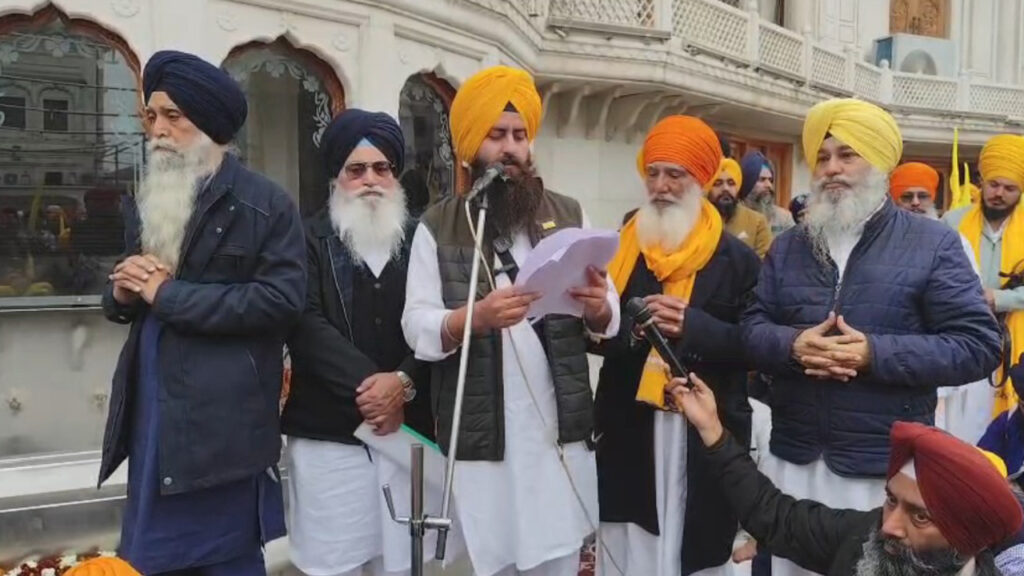
At the conclusion of the conference, participants held a march to Sri Akal Takht Sahib, where a joint declaration was read out by Dal Khalsa acting president Paramjit Singh Mand on behalf of all four organizations. He was joined by Bhai Daljit Singh and Bhai Rajinder Singh Mughalwal of the Panch Pardhani Jatha, Prof. Mohinderpal Singh of Shiromani Akali Dal Amritsar (Mann), and Bhai Bhupinder Singh of the Bhai Jagtar Singh Hawara Committee.
⊕ ALSO READ – Sikh Bodies Recall Sarbat Khalsa 1986, Announce Joint Initiatives at Amritsar Conference
The declaration announced two major initiatives:
First, the organizations resolved to develop a formal and contemporary institutional framework for convening Sarbat Khalsa and adopting Gurmata. The declaration stated that, through consultations with Panth-oriented groups and institutions worldwide, a draft code and procedural framework would be placed before the Khalsa Panth at Sri Akal Takht Sahib. This framework would define, in present-day conditions, how Sarbat Khalsa should be convened and conducted, including norms for participation and representation, deliberation and decision-making processes, institutional safeguards, transparency standards, and mechanisms for implementing and reviewing Gurmata in accordance with Khalsa traditions and principles.
Second, the declaration announced that on the 40th anniversary of the Khalistan Declaration—29 April 2026—a new joint policy document would be presented before the Sikh world. The statement recalled that on 29 April 1986, the Khalistan Declaration marked a milestone in the Sikh struggle for freedom. The organizations resolved to commemorate this anniversary at the Panthic level in 2026 and to observe 29 April every year thereafter as a day of remembrance. The aim, the declaration said, is to send a clear message to the people of Punjab and the international community that Sikhs seek to regain their sovereignty. It further stated that the envisioned Khalistan would be a continuation of the historical Sikh tradition of governance—from Baba Banda Singh Bahadur’s Khalsa Raj, through the Misl period’s Dal Khalsa administration, to the Sarkar-e-Khalsa under Maharaja Ranjit Singh.
In this context, the organizations announced that, drawing upon the experiences of the past four decades of struggle and keeping in view current Panthic and international conditions, they would coordinate with pro-Khalistan Sikh groups and institutions to prepare a joint strategic policy document outlining the future course of the Khalistan movement.
Reaffirmed Commitments
The declaration also reiterated two core pledges:
The first reaffirmed commitment to the goal of a sovereign and independent Punjab, presently articulated as Khalistan—envisioned as a state structure based on Sikh political philosophy and Gurmat principles, ensuring justice, dignity, freedom of conscience, and the welfare of all, in harmony with Sikh ideals of principled governance.
The second pledge emphasized the transfer of leadership to committed youth. The declaration announced an intention to bring dedicated and ideologically grounded young Sikhs to the forefront of revolutionary Sikh politics, under collective initiatives and with guidance from those who have long contributed to the leadership of the struggle.

![Jagtar Singh Jaggi Johal [File Photo]](https://sikhsiyasatnews.net/wp-content/uploads/2022/03/Jaggi-Johal-1.jpg)