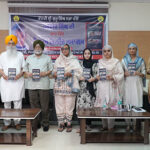
Chandigarh (Panjaab Lawyers): A detailed discussion was recently held on Bhai Narain Singh Chaura’s book “Khalistan Virudh Sazish“ (Conspiracy Against Khalistan), which was written as a fact-based rebuttal to the controversial book “The Khalistan Conspiracy” authored by former RAW officer G.B. Sidhu. During the event, Sikh scholars unanimously rejected G.B. Sidhu’s book, terming it baseless and part of a deliberate Delhi-sponsored campaign aimed at character-assassinating the 20th-century Sikh martyr and iconic leader, Sant Jarnail Singh Bhindranwale, as well as maligning the broader Sikh struggle.

Speakers at the event emphasized that advocating for Sikh sovereignty—be it under the terms of Sikh Raj, Sikh Homeland, Halemi Raj, or Khalistan—is a legitimate right and a necessity for the welfare of all. The event was hosted by Panjaab Lawyers and held at Central Sri Guru Singh Sabha, Sector 28, Chandigarh.

The discussion was chaired by Justice (Retd.) Ranjit Singh of the Punjab and Haryana High Court. Justice Ranjit Singh noted that he had also presided over the earlier discussion on G. B. Sidhu’s book, during which he first met Bhai Narain Singh Chaura. At that time, Narain Singh Chaura had already challenged the contents of G.B. Sidhu’s book with factual arguments, which have now been thoroughly documented in his published work. Justice Singh stated that Bhai Narain Singh Chaura’s book provides a solid foundation to outright reject Sidhu’s narrative.

Advocate Jaspal Singh Manjhpur, head of Punjab Lawyers, conducted the stage proceedings effectively. The discussion, held from 12:30 PM to 4:00 PM, featured contributions from more than a dozen speakers.

Bhai Mohkam Singh and Bhai Kanwar Singh Dhami recalled the events of 1984 and praised Bhai Narain Singh Chaura’s effort in countering misinformation.

Former IAS officer Sardar Gurtej Singh elaborated on the difference between Khalistan and Khalsa Raj, explaining that the former is a slogan rooted in emotion, while the latter is a conceptual vision.

Prof. Azadveer Singh from Guru Nanak Dev University highlighted that the Sikh struggle began with Guru Nanak Sahib and continues today. He emphasized the importance of deeply understanding Khalistan and praised Bhai Narain Singh Chaura’s book for its grounding in eyewitness accounts—unlike G. B. Sidhu’s book, which is based on falsehoods and aims to distort the image of Sikh saints and the movement.

Mahinderpal Singh Patiala, a leader of Shiromani Akali Dal Amritsar (Mann), described the book as a milestone in realizing the vision of Khalistan.
Senior journalist Jaspal Singh Sidhu, who has known Bhai Narain Singh since 1983, stated that the book revealed many new insights even to him.

Senior journalist and author Jagtar Singh, who read both books, said that beyond documenting the Sikh struggle, the books also reflect the role of governments and highlighted how the ongoing Sikh resistance continues to shape India’s geopolitical landscape. He stressed the need to acknowledge certain truths about the movement.

Dr. Gurdarshan Singh Dhillon said that the Sikh identity and Khalistan are inherently intertwined, and that Bhai Narain Singh’s book reasserts the Khalistani perspective.

Dr. Sewak Singh praised Bhai Narain Singh Chaura as both a warrior and a writer—an uncommon combination among freedom fighters. He also pointed out that not every narrative by opponents needs to be answered, as responding sometimes amplifies their falsehoods.

Bhai Paramjit Singh Mand remarked that the struggle for Khalistan operates on many levels, and everyone should contribute according to their capacity.

Principal Khushal Singh (Kendri Sri Guru Singh Sabha) concluded the session by thanking the participants and assuring continued hosting of such discussions in the future.

Other attendees included Bapu Gurcharan Singh, Kanwarpal Singh Bittu, Harcharanjit Singh Dhami, Satnam Singh (Paonta Sahib), Jaspal Singh Dhillon, Advocate Simranjit Singh, Advocate Rajvinder Bains, Bibi Harbans Kaur, Bibi Kulbir Kaur Dhami, Bibi Jasmeet Kaur, Surinder Singh Kishanpura, Manjinder Singh Husainpura, and Gurdarshan Singh Bahia.