
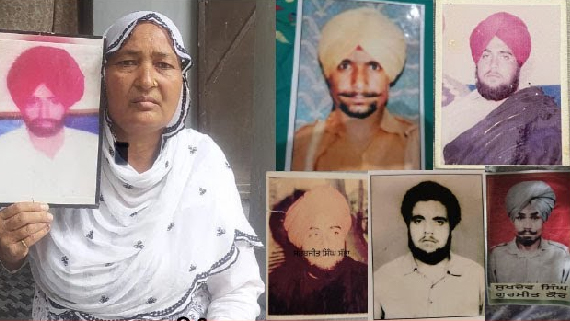
Mohali: A special CBI court in Mohali on 4 August 2025 sentenced five retired Punjab Police officers to rigorous life imprisonment for the cold-blooded killing of seven individuals — including three special police officers (SPOs) — in two fake encounters staged in 1993. While acknowledging the seriousness of the crimes, the court declined to impose the death penalty, citing the convicts’ advanced age and the prolonged legal process.
Court Condemns “Profoundly Inhumane” Acts
CBI Special Judge Baljinder Singh Sra, who delivered the verdict, also imposed a fine of ₹3.5 lakh on each of the convicts. The court directed that the amount be paid to the legal heirs of the victims. In his remarks, the judge strongly condemned the conduct of the accused, calling their actions “unlawful, morally bankrupt, and profoundly inhumane.” He further stated that the officers acted with “sheer venality and callousness,” displaying complete disregard for human dignity and life.
Convicted Officers and Charges
The following retired officers were convicted on August 1 under various sections of the Indian Penal Code, including charges of criminal conspiracy, murder, destruction of evidence, and fabrication of records:
Bhupinderjit Singh (61), then DSP, later retired as SSP
Devinder Singh (58), then ASI, later retired as DSP
Gulbarg Singh (72), then ASI
Suba Singh (83), then Inspector
Raghbir Singh (63), then ASI
Five other accused — Inspector Gurdev Singh, Sub-Inspector Gian Chand, ASI Jagir Singh, and Head Constables Mohinder Singh and Aroor Singh — died during the trial. Another accused turned approver and testified for the prosecution.
Origins of the Case: Revelation of Mass Cremations
Advocate Jagjit Singh Bajwa, who represented the victims’ families along with the CBI, explained that the case emerged from investigations into mass cremations during the militancy period in Punjab. Human rights activist Jaswant Singh Khalra had uncovered records showing the secret cremation of thousands of unidentified bodies, many of which were later found to be victims of extrajudicial killings.

In response to these revelations, the Supreme Court of India handed over the investigation of selected cases to the CBI.
Details of the 1993 Fake Encounters
According to the CBI’s findings, the first incident occurred on June 27, 1993, when a police team led by then SHO of Sarhali police station, Gurdev Singh, illegally detained five men — SPOs Shinder Singh, Desa Singh, Sukhdev Singh, and civilians Balkar Singh and Daljit Singh — from the home of a government contractor. All were residents of Rani Vallah village, Tarn Taran. The men were falsely implicated in a robbery case and taken to the Sarhali police station.

On July 2, 1993, police filed a fresh FIR, falsely alleging that Shinder Singh, Desa Singh, and Sukhdev Singh had absconded with government-issued weapons. Ten days later, on July 12, 1993, police claimed they were escorting a man named Mangal Singh to Gharka village when their team was allegedly ambushed by militants. They reported that Mangal Singh, along with Desa Singh, Shinder Singh, and Balkar Singh, was killed in the ensuing crossfire.
Evidence Contradicts Police Version
However, forensic analysis and post-mortem reports contradicted the police version of events. Ballistic evidence showed that the bullet casings recovered from the scene did not match the weapons allegedly recovered from the deceased. Medical reports revealed that the victims had been tortured prior to death. Despite being identified by two ASIs, the victims were labeled as “unidentified” and cremated as unclaimed bodies — a tactic used frequently during the militancy period to cover up custodial killings.
Second Staged Encounter Later That Month
Just over two weeks later, on July 28, 1993, police allegedly staged another encounter, killing Sukhdev Singh, Sarabjit Singh, and Harvinder Singh. According to the CBI, this operation was also led by then DSP Bhupinderjit Singh and followed the same pattern of false narrative and cover-up.
Long Road to Justice
The case was formally registered by the CBI in 1999 after a complaint by Narinder Kaur, wife of victim Shinder Singh. However, the road to justice was long and arduous. Of the 67 witnesses listed by the CBI, 36 passed away before they could testify, and only 28 ultimately gave evidence in court.

Grave Human Rights Abuses in Punjab During the 1980s–90s
Independent human rights reports have extensively documented widespread and grave human rights violations committed in Punjab during the 1980s and 1990s. Security forces — including the Indian Army, paramilitary units, and the Punjab police — carried out systematic and large-scale abuses targeting the civilian Sikh population. These abuses included custodial torture, extrajudicial killings, fake and staged encounters, secret cremations, and enforced disappearances, all carried out in an organized and coordinated manner.
[For detailed documentation, readers may refer to reports such as Death Silence: Punjab (Asia Watch, now Human Rights Watch), Reduced to Ashes (Ram Narayan Kumar), Smouldering Embers (Voices for Freedom), and Protecting the Killers (Ensaaf and Human Rights Watch).]
Jaswant Singh Khalra’s Revelation of Systematic Abuses
Renowned human rights activist Jaswant Singh Khalra exposed the state’s involvement in mass killings and illegal cremations. He revealed that many of the “unclaimed” and “unidentified” bodies cremated by state authorities were, in fact, Sikh civilians killed in extrajudicial operations — primarily by the Punjab police.
![Shaheed Jaswant Singh Khalra [File Photo]](https://sikhsiyasatnews.net/wp-content/uploads/2020/08/Jaswant-Singh-Khalra.jpg)
Jaswant Singh Khalra obtained official records from three cremation grounds — Durgiana Mandir (Amritsar), Patti, and Tarn Taran. His research revealed over 6,000 cases in which Sikh individuals were unlawfully killed and subsequently cremated as “unidentified and unclaimed” dead bodies.
As a result of his courageous efforts to expose this systematic abuse, Jaswant Singh Khalra was abducted by the police in 1995 and killed while in custody, becoming a victim of the very atrocities he had exposed.
CBI Investigation Against Punjab Police Officials in Selected Cases
While hearing the case related to Jaswant Singh Khalra’s disappearance, Justice Kuldip Singh of the Supreme Court of India directed the Central Bureau of Investigation (CBI) to probe certain cases of enforced disappearances.
Following its investigation, the CBI registered FIRs against several Punjab police officials implicated in serious human rights violations.
Trial Proceedings Delayed by Supreme Court Stay
Before these cases could proceed to trial in the CBI special court, several accused police officials secured a stay on the proceedings from the Supreme Court of India in 2002.
This stay lasted 14 years, during which time the accused officers continued serving in the police force, receiving regular salaries and even promotions. Meanwhile, the victims’ families remained in distress, and many key witnesses passed away before they could testify. As a result, critical evidence deteriorated or was lost over time.
Supreme Court Finally Lifts Stay After 14 Years
In 2016, the Supreme Court finally lifted the stay, acknowledging that no prior sanction was needed to prosecute police officers accused of heinous crimes committed under the guise of official duty. The fact that it took 14 years for the apex court to arrive at such a basic legal conclusion has been widely regarded as a grave miscarriage of justice.
CBI Court and High Court Reject Police Officers’ Pleas for Discharge
Following the lifting of the stay, the accused officers sought to have the charges against them dropped. However, their discharge applications were dismissed by the Special CBI Court. The officers then appealed to the Punjab and Haryana High Court, which, on December 20, 2017, upheld the CBI court’s decision and allowed the trials to proceed.
Lack of Legal Framework for Crimes Against Humanity in India
Although some convictions have been secured in recent years, particularly since 2017, these cases are being tried under ordinary criminal law. India does not have a specific legal framework to define or prosecute crimes against humanity. As a result, the trials fail to fully capture the systematic and widespread nature of the abuses committed by state forces in Punjab during the 1980s and 1990s. The absence of dedicated laws addressing crimes against humanity undermines the severity and historical context of these atrocities, limiting both accountability and recognition of the victims’ suffering.
Only a Fraction of Cases Brought to Trails
The cases that have reached the courts represent only a very small portion of the total human rights violations that occurred during the 1980s and 1990s. While these few trials have confirmed the abuse of power and unlawful killings by police officials, the vast majority of cases were never even registered — let alone investigated or prosecuted. Thousands of victims and their families continue to be denied justice, as the full scale of the atrocities has never been officially acknowledged or addressed by the state.




![Jagtar Singh Jaggi Johal [File Photo]](https://sikhsiyasatnews.net/wp-content/uploads/2022/03/Jaggi-Johal-1-150x150.jpg)
