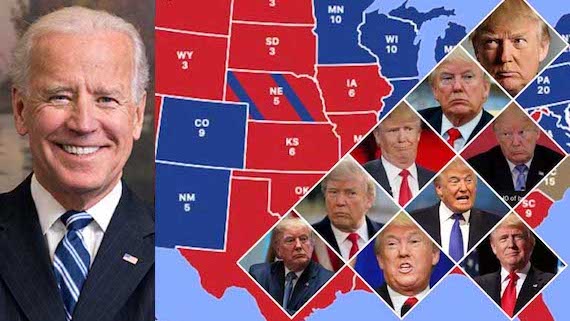
This was the first election since 1992 when an incumbent president failed to win re-election for a second term. With over 75 million votes, Biden received the most votes ever cast for a presidential candidate, beating Barack Obama’s record of 69.5 million votes from 2008.
 The 2020 election saw a record number of ballots cast early and by mail, due to many states relaxing restrictions on mail-in voting in response to the COVID19 pandemic. As a result of a large number of mail-in ballots, some swing states saw delays in vote counting and reporting, leading to major news outlets not projecting a winner until four days later, on 7th November 2020.
Most significantly, Joseph R Biden’s running mate Kamala Harris became the first coloured women to be elected as the Vice President of the United States.
 Such achievements notwithstanding, mandate in the 59th presidential election was not as decisive and emphatic as was being anticipated by pollsters. Trump expanded the support for his policy, as reflected in the voting pattern between 2016 and 2020. In 2016, presidential election Trump polled 62, 984, 828 votes, which is approximately 46 % of the total votes cast. In 2020, votes polled in favour of Trump increased to 71,098,559, which is approximately 48% of the total votes cast. (At the time of writing approximately 93 % of the votes have been counted.)
It is apparent that despite the electoral defeat of Donald J Trump in the 59th presidential election, popular support for Trumpism has expanded.
 The pyrrhic victory of the Democrats is underscored by the existing state of play in the US Senate election 2020. The Republican Party won 18 seats, thus having a tally of 48 seats in the US senate. The Democratic Party won 13 seats and holds 46 seats in the Senate. Two seats are held by the Independents. Requiring 51 seats to have a majority, the fate of the US Senate rests on the two runoff elections in Georgia, where neither party managed to secure 50% or more of the total votes cast.
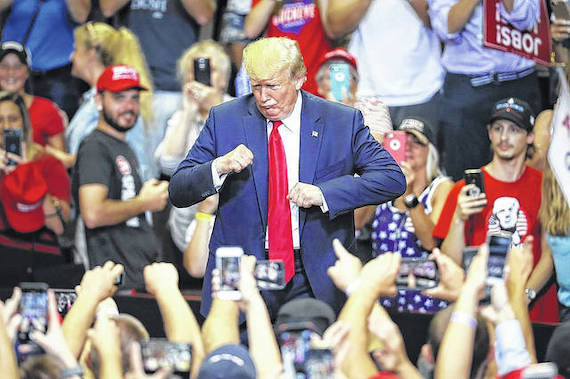
Media analysts and pollsters are crediting Trump’s carnivalesque campaign for the enthusiastic in-person voter turnout on November 3, for presidential election 2020.
 Trump’s success in eliciting overwhelming turnout of supporters is fundamentally a consequence of his connect with a subterranean ideology that has been a part of US politics since the inception of the US as a nation. That which we know as Trumpism is an amalgamation of deeply conservative dispositions, beliefs and ideas on, inter alia, race, gender, class and scientific temper. This neo-conservative ecosystem is certainly not Trump’s creation, but he became the bridgehead for the intrusion of these ideas in mainstream politics.
 The topography of neo-conservative politics is constituted by an ensemble of organizations and groups. It will be difficult to establish systematic ties between them; they adhere to widely different organizational principles and have little in common except for a filiation to the subterranean ideology. At one end of this ensemble of organizations are amorphous groups with no recognized leader, political centre or structured organization, QAnon is a typical example of such groups, at the other extreme are the clandestine, highly disciplined and hierarchically organized groups of white supremacists and right-wing militias and finally, there are radio talk shows, cable news and far-right websites such as Breitbart News, a website which is the platform for the alt-right.
This subterranean ideology and the groups affiliated to it, even when it provided a significant proportion of the votes cast for the Republican party, is neither a part of the party nor is within its control. The coupling of alt-right with the Grand Old Party is entirely the handiwork of Trump and his acolytes.
 Herein lies the basis of the stranglehold that Trump seems to have over the Republican Party. It follows that electoral defeat notwithstanding; Trump and his trusted lieutenants would be firmly in the saddle of the party and it will be obligated to continue the collision course with the Democrats and other perceived enemies. In short, divisive politics that was the hallmark of the Trump presidency would persist even after his electoral defeat.
Any analysis of the increasing fragility of polity in the US of A will be incomplete without accounting for the significant mutations in the formal political parties of the USA. Significant fault lines have emerged within both the Republican and the Democratic Party.
Since the 58th presidential election 2016, the establishment of both the Republican and Democratic party is under the threat of being swamped by a radical wing. The Democratic party is facing a mounting challenge from the left that is growing increasingly impatient with the glacial pace of socio-political and economic reforms.
Bernie Sanders and The Squad Democrats (a group of four women elected in the 2018 United States House of Representatives elections, made up of Alexandria Ocasio-Cortez of New York, Ilhan Omar of Minnesota, Ayanna Pressley of Massachusetts, and Rashida Tlaib of Michigan) have been articulating the anxieties and aspirations of the left-wing of the Democratic party. This group has already mounted two unsuccessful challenges to occupy CenterStage of Democratic party. They have also been the motivating force behind movements of police, medical and educational reforms as well as an equitable and just wage structure.
The establishment in the Republican party has already been vanquished by the alt-right challenge mounted under the leadership of Trump and Stephen Kevin Bannon. It is a symptom of this capitulation of the establishment conservatives that Abraham Lincoln’s party has lately become the vehicle for the remnants of confederate ideology in US politics.
Establishment in both the parties has displayed ineptitude in addressing this challenge. Democrats pulled defeat from the jaws of victory in the 58th presidential elections owing to the mishandling of the left-wing of their party. That the conservative establishment had some role to play in Trump’s electoral defeat is evident in the voting trends in the election of the Senate and the President in some important swing states.
Biden’s victory in Arizona and Massachusetts had the weight of the Republican supporters -late John McCain and Mitt Romney. The upshot of this challenge is that while the Democrats are increasingly being pushed towards a left-wing agenda of reforms that alt-right is pushing the Republicans towards a politics of cultural wars.
In spite of the pious enunciation of Biden, this growing chasm in US domestic politics will be hard to plaster over. In fact, the burning questions that evoked unprecedented voter turnout even in the time of pandemic can hardly be ignored by the Biden administration. However, any decisive action by the Biden administration on COVID19 related public health measures, on police reforms, especially in the face of growing sensitivity on disproportionate police action on coloured communities, on relaxations of emigration norms are all capable of igniting passions and acrimonious street wars.
The founding fathers of the United States may have visualized it as a beacon of freedom for the world, a shining city on a hill; in the current turbulent times, it may be reduced to a house on fire.
Should this concern India or the South Asian sub-continent? One must speculate the impact of a divided US on its capacity to regain the leadership of multilateral institutions in the face of the rise of China as a potential hyperpower.