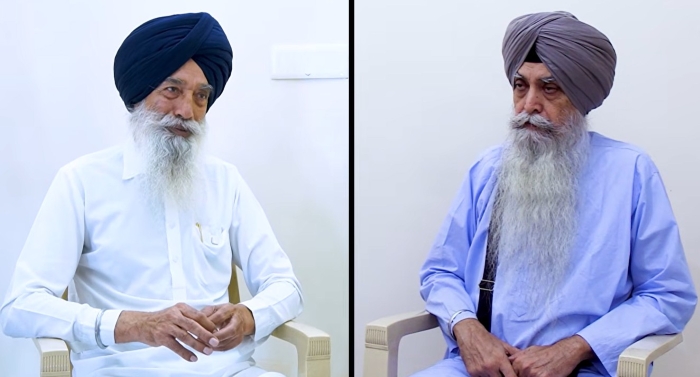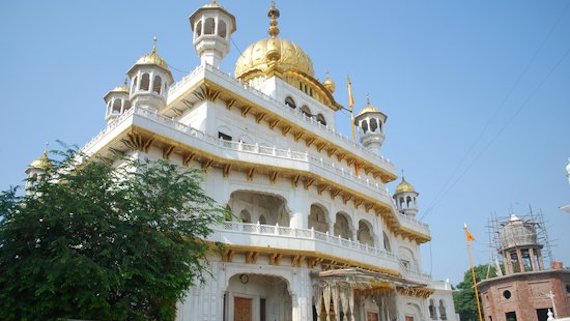
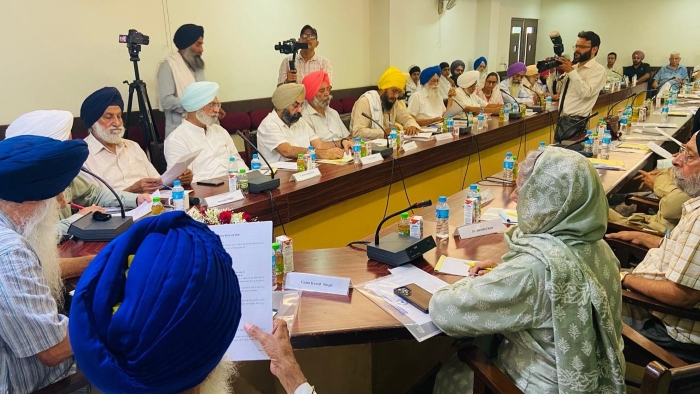
Chandigarh: The International Sikh Confederation organised a discussion on the theme “Akal Takht: Principle and Institution” at the People’s Convention Centre, Sector 36, Chandigarh, on Saturday, June 27, 2026.
Initiating the discussion, Dr. Barindra Kaur said that the International Sikh Confederation was making an effort to bring the subject of the principle and institution of Akal Takht Sahib into the sphere of academic discourse. She said scholars serve as a bridge between principle and institution. Whenever shortcomings arise in the functioning of an institution from the perspective of its founding principles, it is the responsibility of scholars to identify those shortcomings and suggest ways to address them.
On this occasion, Dr. Amarjit Singh Grewal delivered the keynote address. He said that Akal Takht Sahib is not merely a building but a principle. “Akal Takht Sahib is not a position; Akal Takht is the Gurmat-based conscience of the Guru Panth. Akal Takht is not a regime; Akal Takht represents accountable service dedicated to Sarbat Da Bhala (the welfare of all),” he said.
In his paper, Dr. Amarjit Singh Grewal shared his views under various themes, including the foundational principles of Akal Takht, the source of Akal Takht’s authority, contemporary contradictions, the meaning of autonomy, Akal Takht in the transnational era, what Sikhs can offer to the world, how the mission can be advanced, the language of the mission, and a concluding appeal.
Discussing five key tasks concerning the management of Akal Takht Sahib, he said that Akal Takht should have its own constitution, a Sarbat Panthic Parliament should be established, the selection of the Jathedar should be independent, Akal Takht should have a global secretariat, a global Sangat fund should be created, and the decision-making process should be based on justice.
Dr. Kehar Singh appreciated the theoretical direction presented in Dr. Amarjit Singh Grewal’s paper. He said that theoretical discussion has its own importance and necessity, but the greater issue is practicality, which is not being discussed sufficiently. He said that while the theoretical aspect regarding Akal Takht Sahib is clear, there needs to be discussion on what practical steps can be taken. Remaining confined merely to ideas is not enough.
He added that no one, including the current establishment managing affairs of the Akal Takht, should be excluded, and efforts should be made to explore how dialogue can be initiated with everyone. He emphasised the need to think about how to move from theoretical discussions to practical implementation on the ground.
S. Gurpreet Singh, Vice-President of the Institute of Sikh Studies, said that such deliberations are greatly needed within the Sikh community. He appreciated the initiative undertaken by the International Sikh Confederation.
Sikh Siyasat editor Parmjeet Singh Gazi shared key points from a document titled “Takht Sahiban De Parbandh Baare Sujha (Karaj Khetar, Bantar, Paatarta)”, released last year by Panth Sewak Jatha Doaba.
Explaining the fundamental sphere of Akal Takht Sahib, he said that Akal Takht Sahib is the guardian of the pure form of Gurmat, the supreme platform for collective policy decisions, the central axis of Khalsa political institutions, the representative of the entire Gur-Sangat, and the highest guiding authority in matters concerning Dharam Yudh.
He said that the Khalsa Panth follows the principle of collective leadership; therefore, instead of focusing only on a procedure for appointing or removing a single individual as Jathedar, there is a need for comprehensive structural transformation.
Commenting on Dr. Amarjit Singh Grewal’s paper, he said that the paper too focused only on developing a procedure concerning one individual—the Jathedar.
He said that at least five broader institutional frameworks need to be established at this time: Global Gur-Sangat Representative Body, Sarbat Khalsa, Panch Pardhani Panchayat (based on Khalsa principle of collective leadership), Takht Sahib Sewa Sambhal Jatha, and a framework of rules regarding the Jathedar of the Takht Sahib.
Giani Kewal Singh, head of the Panthic Talmel Sangathan, said that efforts had been made earlier to formulate a system regarding the appointment and retirement of the Jathedar of Akal Takht Sahib, but despite those efforts the condition of the management system continued to deteriorate. Therefore, some practical initiative is required to correct the situation.
He proposed that efforts should currently be made to establish a “shadow management system.”
Senior former journalist Jaspal Singh Sidhu said that the structure of the modern nation-state is complex, and Sikh institutions have not been developed to engage at that level. He said that the eighteenth century is often viewed very idealistically among Sikhs, while insufficient attention is paid to the shortcomings and declines that also occurred during that period.

He said that after the struggle to bring Gurdwara management under Panthic control, the first Shiromani Committee that emerged through that movement brought considerable clarity at the level of principle. However, after the 1925 Act and especially after 1947, electoral politics increasingly dominated the Shiromani Committee.
He said that state interference in Sikh affairs began with the Gurdwara Act of 1925. At present, establishing a proper framework for Akal Takht Sahib is extremely necessary, and practical steps must be taken in that direction. He said the need of the hour is not reformist initiatives but revolutionary ones.
Former senior journalist Karamjit Singh referred to earlier efforts to create a framework regarding Akal Takht Sahib and the appointment and retirement of Jathedars. He said that before launching any new initiative, documents and experiences from previous efforts must be studied.
Commenting on Dr. Amarjit Singh Grewal’s paper, he said that describing Akal Takht as a principle and not a building is like separating the soul from the body.
He further said that the paper describes the status of Akal Takht Sahib as autonomous, whereas Akal Takht Sahib is sovereign, not merely autonomous.
Jaswant Singh Zafar said that he was the person with the least knowledge regarding the subject under discussion. He said that a major dilemma among Sikhs is that they present themselves as the answer by referring to their own principles, but criticise others by referring to their practices.
S. Gurbir Singh, president of ‘Institute of Sikh Studies‘ said that most of the discussion was focused on Akal Takht Sahib, whereas the conversation should include all Takht Sahibs.
Speaking about the current management system, he said that these institutions are functioning under state laws, which effectively places the Takhts under government legislation. He pointed out that under the law, Sikh Takhts are treated as Gurdwaras rather than Takhts.
He said Sikhs need to examine this entire situation and develop their own Sikh jurisprudence.
He added that Sikhs often discuss the past extensively, but there is a need to create structures for the future. “We do not have a system, and we must understand that systems have to be built for the future,” he said.
He proposed the creation of an “Institution of Sikh Takht,” which would work for internal and external conflict resolution. He said such an institution would serve as a centre for Gurmat education. The Sikh community must define its own processes, get them recognised by the Sangat, and the Institution of Sikh Takht should formulate Sikh jurisprudence.
After the speakers shared their views, keynote presenter Dr. Amarjit Singh Grewal thanked the scholars who commented on his paper and said that he would revise the paper in accordance with the suggestions received.
Following this, Dr. Balkar Singh delivered his remarks as the chair of the event, and K.P. Singh extended a vote of thanks to all participants on behalf of International Sikh Confederation.