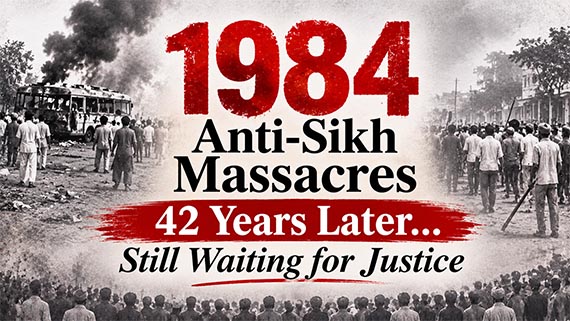
Organized Violence, Attacks on Gurdwaras, and the Failure to Translate Inquiries into Accountability
Gurinder Singh Grewal, MD, FACC
October 2026
Abstract
The approaching forty-second anniversary of the November 1984 anti-Sikh massacres raises a fundamental question: why have repeated investigations failed to produce comprehensive accountability? Contemporary fact-finding reports documented organized attacks on Sikh civilians, homes, businesses, and gurdwaras, alongside allegations of political involvement and police complicity. Successive commissions and committees produced evidence and recommendations, but implementation was often delayed, limited, or inadequate. Later convictions represent important achievements but do not resolve the wider failures of justice.
This article examines the violence, the destruction of Sikh religious institutions, the history of official inquiries, and the consequences of prolonged impunity. It also assesses the “Operation Shanti” allegation, distinguishing its appearance in historical writing from independently verified evidence. The article argues that justice requires prosecutions, institutional accountability, transparent implementation of recommendations, reparations, and preservation of historical memory.
Keywords: Sikhs; November 1984; genocide; pogrom; gurdwaras; commissions of inquiry; impunity; Operation Shanti.
1. Introduction
In November 2026, forty-two years will have passed since the massacres of Sikhs that followed Prime Minister Indira Gandhi’s assassination on October 31, 1984. The assassination supplied the immediate context for the violence. It did not justify attacks on Sikh civilians or diminish the government’s responsibility to protect them.
The central issue is not simply that investigations were absent. Numerous investigations took place. The deeper problem concerns the gap between documenting wrongdoing and imposing consequences.
The contemporary report Who Are the Guilty?, produced jointly by the People’s Union for Democratic Rights and the People’s Union for Civil Liberties, rejected the explanation that the violence was merely a spontaneous expression of grief. Its investigators identified coordinated attacks and alleged acts of commission and omission involving Congress (I) politicians and administrative authorities (PUDR & PUCL, 1984).
A historically accurate assessment must acknowledge subsequent convictions.
Nevertheless, limited convictions obtained decades later cannot be equated with comprehensive justice for a mass atrocity.
2. Organized Violence and the Targeting of Sikh Identity
The PUDR–PUCL investigation described recurring patterns across different Delhi neighborhoods: mobilization of attackers, identification of Sikh properties, arson, killings, and failures of police protection. Its findings challenged the portrayal of the events as an uncontrolled confrontation between communities (PUDR & PUCL, 1984).
The report also recorded assistance provided by non-Sikh neighbors. This evidence matters because responsibility must be assigned to perpetrators, organizers, and enabling institutions rather than to an entire religious population. Collective blame would reproduce the principle through which innocent Sikhs were themselves targeted.
Ensaaf’s Twenty Years of Impunity subsequently examined the relationship between political participation, police conduct, and failures of accountability. Its analysis presented the massacres and their aftermath as connected problems: violence against a minority population followed by institutional protection of perpetrators (Kaur, 2006).
3. Attacks on Gurdwaras and the Burning Alive of Civilians
The violence extended to Sikh religious institutions. Attacking a gurdwara endangered worshippers and those seeking refuge while also striking at the community’s religious and social life.
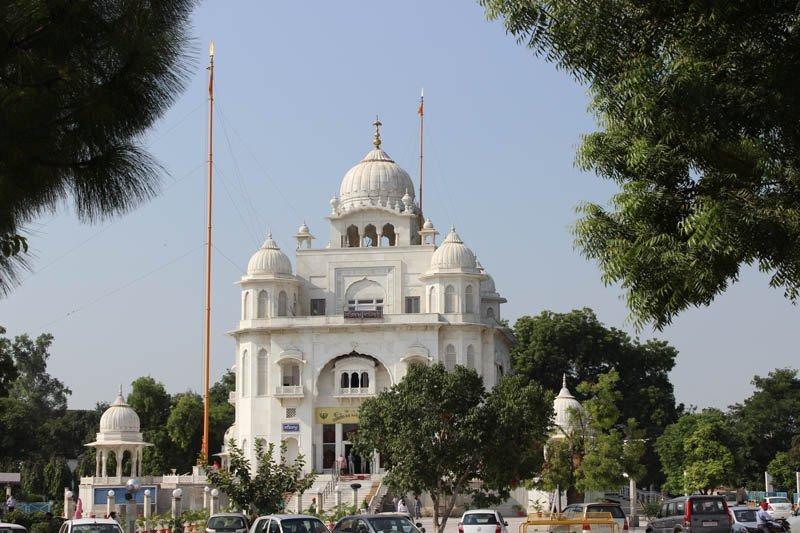
Gurdwara Rakab Ganj
The Nanavati Commission recorded testimony concerning repeated attacks on Gurdwara Rakab Ganj on November 1, 1984. Journalist Monish Sanjay Suri reported seeing the bodies of two Sikhs outside the premises. Other testimony described arson and failures of police protection. The report included conflicting accounts of specific officials and political figures, requiring careful distinction between witness allegations and criminal findings (Nanavati Commission, 2005, discussion of Gurdwara Rakab Ganj).
Gurdwara Singh Sabha, Pul Bangash

The commission recorded testimony that a mob attacked the gurdwara with petrol bombs and kerosene. One witness described a Sikh man being assaulted and burned alive after truck tires were placed around his neck. The account also described two wounded Sikhs subsequently being thrown onto the fire. These details are recorded testimony in an official inquiry; that status should remain explicit when recounting them (Nanavati Commission, 2005, section “Police Station: Bara Hindu Rao”).
Trilokpuri
An archival account reproducing testimony submitted to the Misra Commission describes Inder Singh finding his uncle and granthi Darshan Singh dead outside a burned gurdwara, with burned Sikh scripture on their bodies. The account connects killings with the destruction and desecration of religious institutions (1984 Sikh Archive, n.d.).
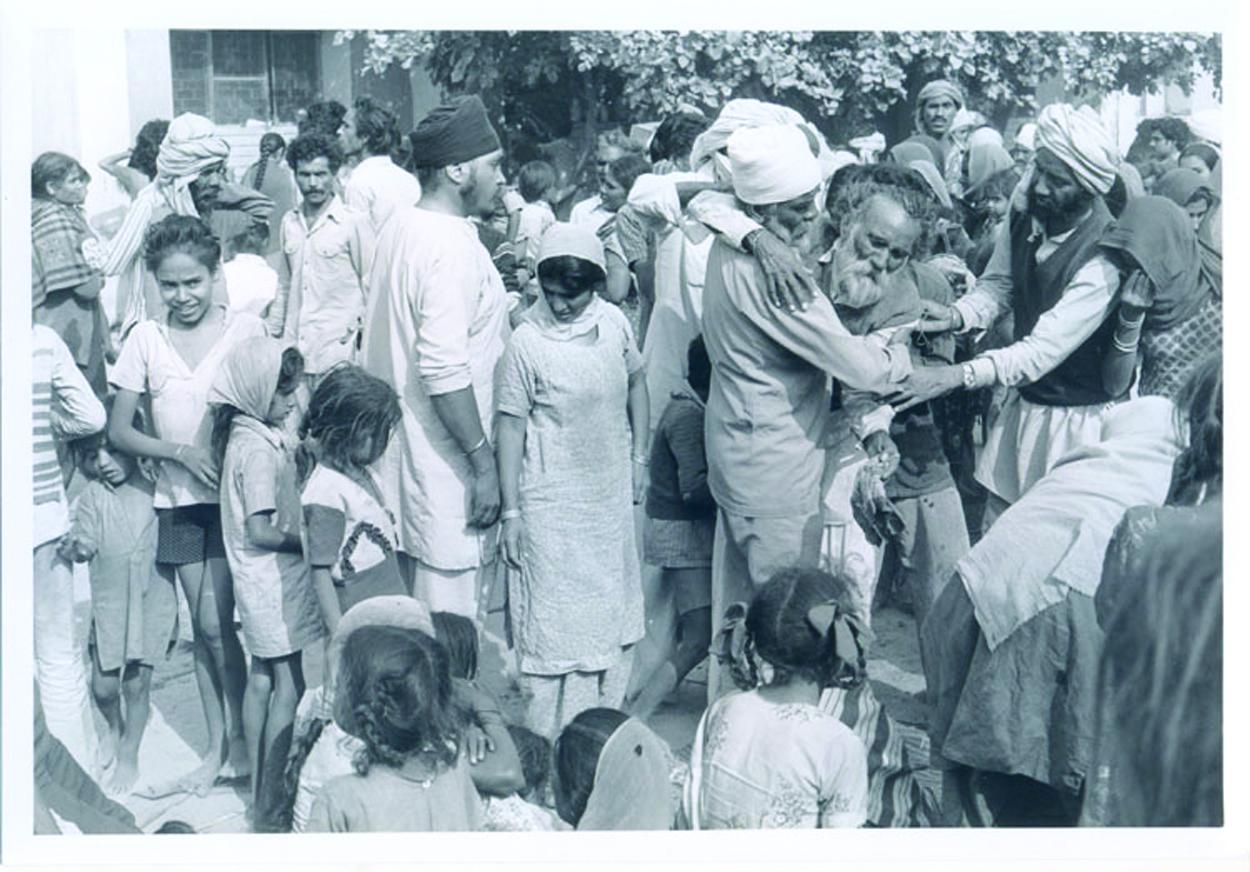
The use of tires to burn victims is also described in the historical account published by Sciences Po’s Mass Violence and Resistance Research Network. These accounts document deliberate methods of killing and terror rather than deaths incidental to public disorder (Sciences Po, 2009).
Taken together, attacks on civilians, gurdwaras, and sacred scripture support an analysis of religious persecution. Their relevance to genocide must be evaluated alongside evidence of the perpetrators’ specific intent.
4. Repeated Inquiries and Inadequate Implementation
The number of inquiries depends on whether commissions, committees, supervisory panels, and special investigation teams are counted separately. Human Rights Watch referred to ten government-appointed bodies in 2014; Amnesty International reported at least twelve commissions and committees by 2017. These figures describe different assessments at different times rather than a single settled count (Human Rights Watch, 2014; Amnesty International India, 2017).
Selected inquiries illustrate the prolonged process:
| Inquiry / Committee | Year | Purpose | Findings / Outcome |
|---|---|---|---|
| Marwah inquiry | 1984 | Examine police conduct | Its work was halted before completion and submission of a final report. |
| Ranganath Misra Commission | 1985 | Investigate the violence and recommend preventive measures | Its report led to further committees rather than comprehensive criminal accountability. |
| Ahuja Committee | 1987 | Establish Delhi’s death toll | Determined that 2,733 deaths had occurred in Delhi. |
| Kapur–Mittal Committee | 1987 | Examine police failures | Produced separate reports; Mittal’s findings identified failures involving numerous police personnel. |
| Jain–Banerjee and successor committees | — | Examine registration and investigation of criminal cases | Repeated scrutiny of complaints illustrated unresolved failures in the original criminal process. |
| Nanavati Commission | 2000–2005 | Reassess evidence and recommend action | Recommended further examination of specified cases and action concerning police failures. |
| Central government SIT | 2015 | Reinvestigate cases | Its closure decisions became the subject of further scrutiny. |
| Supreme Court-appointed SIT | 2018 | Examine 186 cases | Demonstrated that major questions remained unresolved more than three decades later. |
Sources: Human Rights Watch (2014); Tripathi (2018); Amnesty International India (2017); Nanavati Commission (2005).
These bodies did not all have identical powers. Establishing a death toll, recommending disciplinary action, investigating crimes, and determining guilt are different functions. A commission’s findings do not, by themselves, constitute a criminal conviction.
Nevertheless, the multiplication of inquiries raises a serious institutional question: why did evidence and recommendations so often lead to another review instead of timely, effective action?
5. How Recommendations Failed to Become Accountability
The government’s initial response to the Nanavati report illustrates this problem. The published Action Taken Report cited retirement and related legal difficulties when responding to recommendations concerning several police officials. In other instances, it proposed further consultation or declined additional action against political figures. It also accepted general recommendations for police independence and more effective responses to communal violence (Government of India, 2005, as reproduced in Outlook).
Kaur’s analysis criticized the government for emphasizing restrictions on departmental proceedings while failing adequately to pursue possible criminal responsibility. This distinction is essential: administrative discipline and prosecution for criminal offenses are separate mechanisms (Kaur, 2006, pp. 135–136).
The article’s institutional argument is that delay can become self-reinforcing:
-
Inadequate initial investigation weakens the evidentiary record.
-
Subsequent inquiries identify failures but require further governmental action.
-
Delayed implementation allows witnesses to age and evidence to deteriorate.
-
Later proceedings encounter difficulties partly created by earlier failures.
This is an analytical interpretation of the documented history. It does not mean that every recommendation was ignored or that no official action occurred. Rather, implementation was insufficient to secure comprehensive accountability.
Amnesty International’s 2017 assessment provides a concrete example. It reported that the 2015 SIT had closed 241 cases and filed charges in twelve, and called for effective investigations, witness protection, reparations, and police reform (Amnesty International India, 2017).
6. Later Convictions and the Continuing Justice Deficit
On December 17, 2018, the Delhi High Court convicted Sajjan Kumar in a case concerning five killings and the burning of a gurdwara. The judgment characterized the broader November 1984 killings as “crimes against humanity”. It examined the obstacles posed by political patronage and law-enforcement failures (State through CBI v. Sajjan Kumar & Others, 2018).
Kumar received another life sentence in February 2025. He was acquitted in a separate case in January 2026 and died in August 2026. These distinct outcomes must be reported separately; neither an acquittal nor a conviction in one case determines every other allegation (The Indian Express, 2025, 2026; The Times of India, 2026).
The convictions were meaningful achievements. They also reveal the extraordinary duration of the struggle. Justice obtained after thirty-four or forty years cannot restore the decades survivors spent seeking recognition and redress.
7. Genocide and the Evidentiary Standard
Under Article II of the Genocide Convention, genocide requires specified acts committed with intent to destroy a protected group, in whole or in part. Sikhs constitute a religious group within that framework, but establishing genocide requires evidence of the necessary destructive intent, alongside the prohibited acts (United Nations, 1948).
The targeting of Sikh civilians and religious institutions warrants serious examination under this standard. Historical and human-rights descriptions of genocide should nevertheless be distinguished from particular judicial findings and the offenses underlying individual convictions.
Such precision strengthens the case for accountability by making clear what the evidence establishes and what requires further investigation.
8. “Operation Shanti”: Attribution and Verification
The supplied historical narrative alleges that “Operation Shanti” was a plan for a larger massacre of Sikhs around Guru Nanak’s birth anniversary in November 1984. An online account attributes the allegation to Sangat Singh’s The Sikhs in History and repeats claims connecting the alleged plan with the assassination of Indira Gandhi (Shaheed Khalsa, n.d.).
Source: https://www.shaheedkhalsa.com/shanti.html?utm_source=chatgpt.com
However, the sources reviewed here do not provide an authenticated operational order, independently corroborated planning record, or judicial finding establishing that alleged operation.
It should therefore be presented as an attributed allegation requiring investigation. Claims that particular individuals learned of the plan, or that it explains their subsequent actions, also require independent corroboration.
The documented evidence concerning the November massacres stands independently of this allegation. Further archival disclosure could help evaluate it without predetermining the answer.
8. “Operation Shanti”: Allegations of Advance Planning and Their Evidentiary Limits
The accompanying slides present an account of an alleged operation referred to in the existing article as “Operation Shanti.” They allege that preparations for widespread attacks on Sikhs preceded Indira Gandhi’s assassination on October 31, 1984. According to this narrative, the proposed violence would have involved killings, looting, and arson against Sikh communities across India, with recruited criminals awaiting instructions to act. The slides further allege that the plan was developed under Gandhi’s supervision and that some military officers advised against it. These assertions concern advance planning and responsibility at the highest levels of government; they must therefore be distinguished from independently established findings.
The narrative also links the alleged preparations to military readiness and diplomatic exchanges with Pakistan. It claims that information escaped through the office of P. C. Alexander, Gandhi’s principal secretary, and that Pakistan’s president, General Zia-ul-Haq, sought an unconditional meeting between the two countries to avert conflict. The slides identify October 25, 1984, as the date of a Pakistani diplomatic approach. They further describe Gandhi’s visit to Kashmir on October 27 and an alleged subsequent assurance from Army Chief General A. S. Vaidya concerning military preparedness. However, diplomatic contacts and military readiness would not, by themselves, establish the existence or purpose of the alleged anti-Sikh operation.
A second part of the account alleges that R. K. Dhawan, Gandhi’s private secretary, disclosed the plan to her bodyguard Beant Singh. It interprets Beant Singh’s subsequent actions, together with those of Satwant Singh, as an attempt to prevent the alleged operation. The slides invoke the Thakkar Commission’s examination of Dhawan’s conduct, but scrutiny of an individual does not establish that he disclosed such a plan or that the disclosure motivated the assassination. Those specific claims require corroboration from the commission’s actual findings and other reliable evidence.
The slides describe the shooting of Gandhi by Beant Singh and Satwant Singh on October 31, followed by Beant Singh’s death and Satwant Singh’s injury and subsequent execution. They also allege that Beant Singh instructed Satwant Singh to avoid harming Dhawan and that Dhawan later made inquiries about Beant Singh from the hospital. These additional details, particularly those concerning conversations, intentions, and private communications, should remain explicitly attributed unless supported by verifiable testimony or records.
Finally, the slides allege that an official diplomatic telex circulated at approximately 11:00 a.m. on October 31 identified two Sikh guards and an additional clean-shaven individual as the assassins. They also claim that numerous Sikh police personnel were removed from duty. Assessing these assertions requires original communication and relevant police deployment records. An early report, even if authenticated, would require examination for accuracy and subsequent correction.
The account therefore raises questions for archival investigation rather than establishing a verified chain of events. The existing article identifies an online narrative attributing the “Operation Shanti” allegation to Sangat Singh’s The Sikhs in History (Shaheed Khalsa, n.d.). That attribution should not be treated as independent corroboration of every detail in these slides. The documented evidence of organized anti-Sikh violence and failures of state protection remains significant independently of whether the alleged earlier operation can be substantiated.
9. Requirements for Meaningful Justice
Conclusion
Forty-two years after November 1984, the record demonstrates organized violence, attacks on Sikh religious institutions, grave failures of protection, and an exceptionally prolonged struggle for accountability.
The claim that nothing happened overlooks convictions and other official measures. The claim that justice has been completed overlooks the scale of unresolved wrongdoing and the decades of delay.
The central failure lies in the repeated gap between inquiry and implementation. Reports can preserve evidence and identify responsibility, but their value depends on effective follow-through. For survivors and their descendants, meaningful justice requires criminal accountability, institutional transparency, reparations, and an honest public record.
References
1. Amnesty International India. (2017, October 31). 1984 Sikh massacre: 33 years on, justice still eludes victims. Amnesty International.
2. 1984 Sikh Archive. (n.d.). Sikh faith targeted—article and archival references.
3. Government of India. (2005). Action Taken Report on the Nanavati Commission findings [Excerpts reproduced in “The Action Not Taken Report”]. Outlook.
4. Human Rights Watch. (2014, October 29). India: No justice for 1984 anti-Sikh bloodshed. Report.
5. Kaur, J. (2006). Twenty years of impunity: The November 1984 pogroms of Sikhs in India (2nd ed.). Ensaaf. Report.
6. Nanavati Commission. (2005). Justice Nanavati Commission of Inquiry: Report, Volume I. Government of India. Official report.
7. People’s Union for Democratic Rights, & People’s Union for Civil Liberties. (1984). Who are the guilty? Report of a joint inquiry into the causes and impact of the riots in Delhi from 31 October to 10 November 1984. Reproduced report.
8. Sciences Po, Mass Violence and Resistance Research Network. (2009). The anti-Sikh pogrom of October 31 to November 4, 1984, in New Delhi. Historical account.
9. Shaheed Khalsa. (n.d.). Operation Shanti [Account attributing the allegation to Sangat Singh]. Source. Used for attribution, not independent verification.
10. State through CBI v. Sajjan Kumar & Others, Criminal Appeal No. 1099/2013 (Delhi High Court, December 17, 2018). Judgment.
11. The Indian Express. (2025, February 25). “Brutal, reprehensible”: Court hands Sajjan Kumar life term in another anti-Sikh riots case. Article.
12. The Indian Express. (2026, August 20). Ex-Congress MP Sajjan Kumar, jailed for murder during ’84 anti-Sikh riots, dies. Article.
13. The Times of India. (2026, January 22). 1984 anti-Sikh riots case: Delhi court acquits ex-Congress MP Sajjan Kumar. Article.
14. Tripathi, R. (2018, January 15). The unending tragedy of 1984 anti-Sikh riots: 11 probe bodies in 33-year journey—the Indian Express.
15. United Nations. (1948). Convention on the Prevention and Punishment of the Crime of Genocide, Article II. Convention.
Source note: No specific factual claim has been attributed here to Giani Zail Singh’s memoir because the relevant passage has not yet